'/%3E%3C/svg%3E)
Description
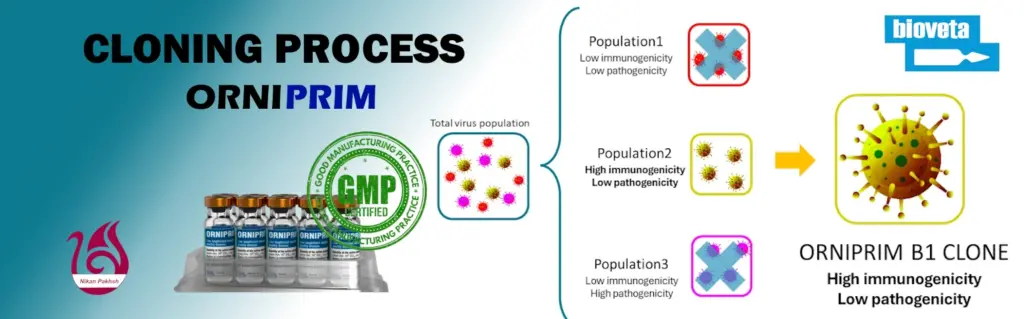
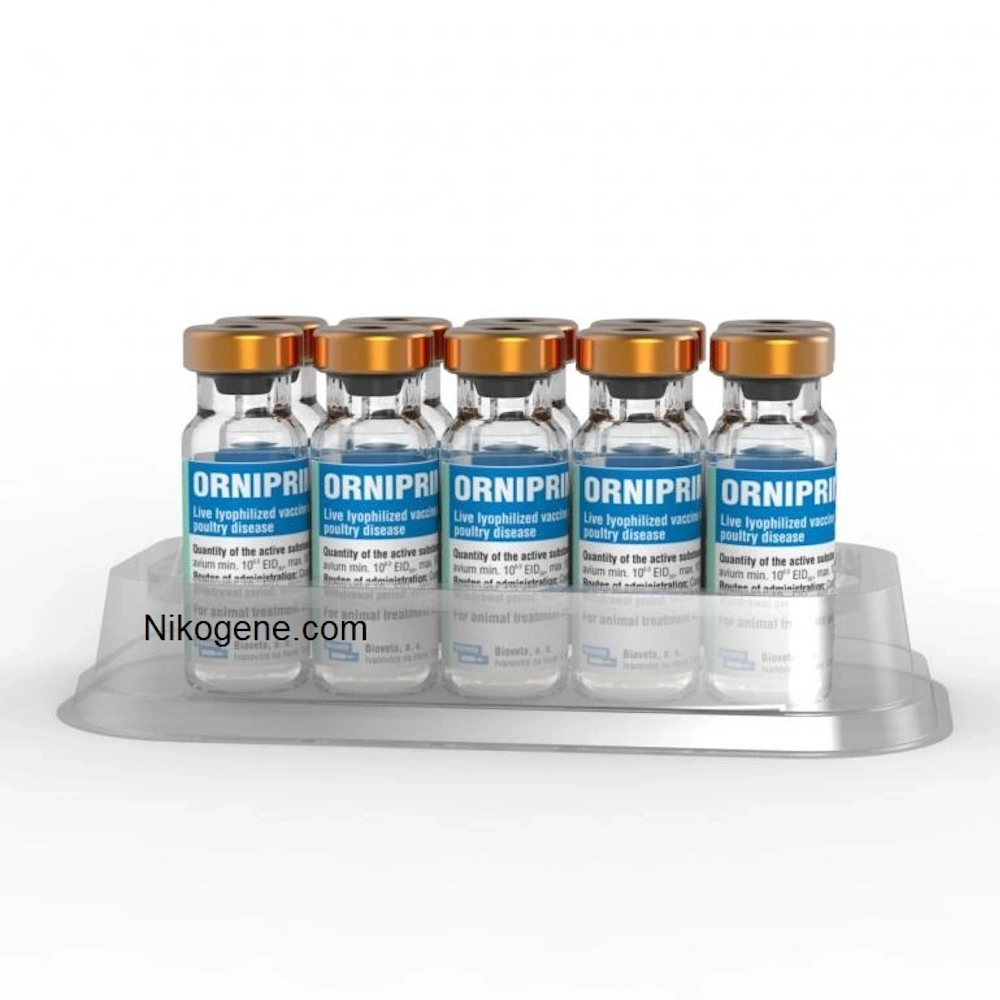
ORNIPRIM CLONE B1
Genetic stability achieved through cloning prevents reversion to virulence. Combined with minimal post-vaccination reactions and the induction of specific local immunity, ORNIPRIM CLONE B1 is considered a preferred choice for emergency vaccination against Newcastle disease.
Asymptomatic enteric strains, when administered via mucosal routes, have demonstrated lower immunogenic capacity compared to lentogenic strains such as ORNIPRIM.
The V4 strain of Newcastle disease virus induces lower immunity in chicks with maternal antibodies compared to ORNIPRIM and ORNIPEST vaccines³.
Key Scientific Findings
✅ Asymptomatic enteric strains, when used via mucosal administration, show reduced ability to induce immune responses compared to lentogenic strains (ORNIPRIM).
✅ The Newcastle disease virus V4 strain provides weaker immunity in chicks with maternal antibodies compared to ORNIPRIM and ORNIPEST³.
✅ When low doses of Ulster 2C are administered, viral replication in birds older than 18 days is reduced and irregular, whereas low doses of ORNIPRIM replicate efficiently at all ages¹.
✅ Depending on epidemiological conditions, the use of ORNIPEST CLONE and ORNIPRIM CLONE B1 in vaccination programs induces higher protective immunity⁵.
✅ A study demonstrated that administration of live vaccine via drinking water or spray provides protective antibody levels in 53–60% of the flock⁴.
✅ In emergency Newcastle disease vaccination, and subject to clinical judgment, it is recommended to simultaneously administer one dose via drinking water and one dose via spray to reduce viral shedding and viral load².
Vaccine Characteristics
✅ Replication in the respiratory and gastrointestinal systems¹
✅ Minimal post-vaccination reactions
✅ Genetic stability due to cloning, preventing reversion to virulence
✅ Induction of both specific systemic and local immunity
✅ Suitable for Emergency Vaccination
Composition:
Each dose contains attenuated strains of Newcastle disease virus Bio 52, NDV B1 106,0107.5 EID50 and infectious ¨bronchitis virus Bio 53, IBV H 120 103.0 – 104.8 EID50
Target species:
Broilers, breeders and commercial layers
Indications:
Intended for administration to healthy chickens as an aid to prevent infectious bronchitis and Newcastle disease.
Advantage of incorporating both vaccines into a single vaccine is to:
- reduce double vaccination stress on chickens,
- reduce cost and work load of double vaccination,
- provide reasonable gap for other vaccines,
- protect chickens from an early age infection by both disease agents.
Dosage:
The vaccine is administered to day-old chickens by spraying or by drinking water.
For water vaccination, dilute the vaccine in fresh drinking water and provide to chickens using an appropriate drinker. Revaccination can be performed after 4 weeks and 6 weeks following spray or via drinking water vaccination, respectively.
Shelf life:
24 months
Storage:
Store in a refrigerator (2 °C – 8 °C). Do not freeze. Store in a dry place protected from light.
Package:
10 vials each containing 200, 1000, 2500 and 5000 doses.
Registration & Distribution
Exclusive Registration & Importer:
Niko Gene Aria Co.
Nationwide Distributor:
Nikan Pakhsh Be Afarin Co.
References
- Russell, P. (1994). Newcastle disease virus vaccines: Differences between Line C and Line 15I chickens with respect to virus replication and IgA responses in the gut and Harderian gland. Veterinary Immunology and Immunopathology, 42(3–4), 357–365.
- Bioveta a.s. Data on file. Technical and experimental data related to Newcastle disease virus vaccines.
- Comparison of the immunogenicity of Newcastle disease virus strains V4, Hitchner B1 and La Sota in chickens.
Part 2: Tests in chickens with maternal antibodies to Newcastle disease virus. - Degefa, T., et al. (2004). Technical and economic evaluation of different methods of Newcastle disease vaccine administration. Journal of Veterinary Medicine, Series A, 51(7–8), 365–369.
- Sarker, M. T. I., et al. (2021). Comparative efficacy of LaSota, B1 and Mukteswar strain vaccines for Newcastle disease virus (NDV) in layer chickens. Asian Journal of Medical and Biological Research, 7(4), 332–338.