'/%3E%3C/svg%3E)
Description

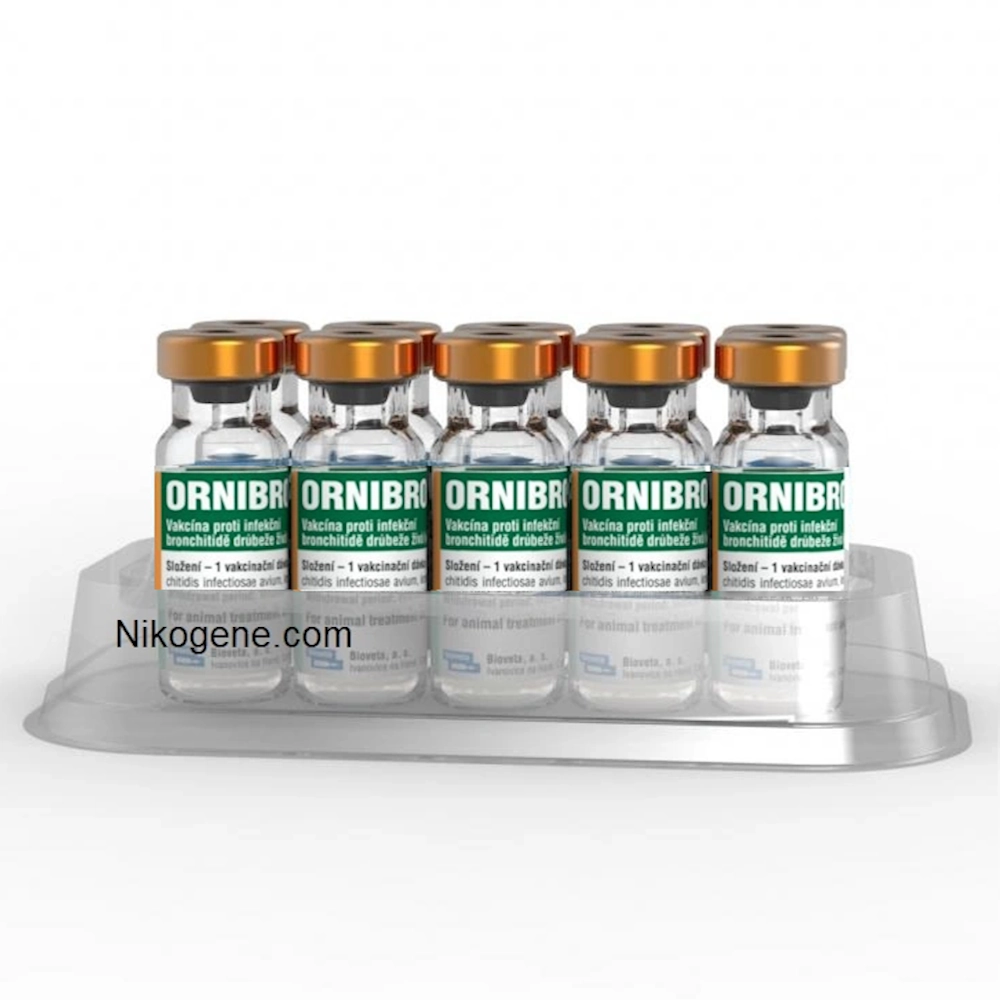
ORNIBRON (D274 + H120)
✅ The limited availability of infectious bronchitis (IB) vaccine strains, together with the antigenic diversity of circulating infectious bronchitis viruses, necessitates the use of vaccines with a broader protective spectrum rather than reliance on vaccines with limited coverage. Moreover, combining such vaccines with other IB vaccines can further expand the breadth of protection against infectious bronchitis¹²⁷⁹.
✅ An effective vaccination strategy should also provide protection against field strains capable of escaping vaccine-induced immunity. Numerous infectious bronchitis virus (IBV) strains exhibit more than 97% similarity in the S1 spike protein to the D274 strain (GI-12), which enhances cross-protective immunity and induces both homologous and heterologous immune responses against other IBV genotypes²⁴⁵.
✅ A vaccination program based solely on the bivalent infectious bronchitis vaccine ORNIBRON (H120 + D274) can provide significant protection against Variant 2 (GI-23), Variant 1 (GI-23), 793/B (GI-13), Massachusetts (GI-1), and D274 (GI-12) strains. This protection is achieved through a marked reduction in renal damage and a significant decrease in viral load associated with fecal shedding. In addition, ORNIBRON significantly reduces **tracheal ciliary damage (ciliostasis)**¹²⁴⁵⁶⁷⁸⁹.
✅ These findings suggest that, in the event of the emergence of new IBV variants, ORNIBRON (H120 + D274) may play a crucial role in the prevention and control of infectious bronchitis.
Under experimental challenge with Variant 2 virus (IS/1494/06), the H120 + D274 combination demonstrated three-fold higher immunogenicity compared with the H120 vaccine alone, along with reduced pathogenicity and a marked reduction in viral shedding via feces⁹.

Tracheal Histopathology⁹
(a) Control group:
Normal respiratory epithelium, intraepithelial glands, and lamina propria connective tissue.
(b) Variant 2 challenge group (IS/1494/06):
Denuded epithelium with partial regeneration, severe lymphocytic infiltration accompanied by germinal center formation, and hemorrhage.
(Five-point star: hemorrhage; arrowhead: epithelial tissue)
(c) H120 group:
Complete loss of the epithelial lining with the presence of scattered lymphocytes in the mucosa, without germinal center formation.
(Arrowhead: epithelial tissue)
(d) H120 + D274 group:
Increased epithelial layer thickness, hyperplasia of mucus-producing cells, and mild lymphocytic infiltration in the mucosa, without destruction of microvilli.
(Arrow: germinal centers; arrowhead: epithelial tissue; four-point star: hyperplasia of mucus-producing cells)

Renal Histopathology⁹
(a) Control group:
Normal renal tubules and glomeruli are observed.
(b) Variant 2 challenge group (IS/1494/06):
The most severe interstitial nephritis is observed in this group.
(c) H120 group:
Leukocyte aggregation similar to that observed in the challenged group.
(d) H120 + D274 group:
No significant pathological changes are observed compared with healthy renal tissue.
Star: interstitial nephritis
Vaccine Specifications
✅ Vaccine Composition:
Each dose of the lyophilized vaccine contains:
- Infectious bronchitis virus strain H120: max. 10⁴․⁸ EID₅₀ – min. 10³․⁰ EID₅₀
- Infectious bronchitis virus strain D274: max. 10⁴․⁸ EID₅₀ – min. 10³․⁰ EID₅₀
(EID₅₀: 50% embryonated egg infective dose)
✅ Target Species:
Broilers, breeders and commercial layers.
✅ Indications:
For the active immunization of chickens from one day of age against Massachusetts serotype strains and D274-related variant strains of infectious bronchitis virus
✅ Administration Routes:
The vaccine may be administered by spray, eye–nose drops (oculo-nasal route), or via drinking water
✅ Shelf Life & Storage Conditions:
Shelf life is 30 months when stored and transported at 2–8 °C, protected from light.
After reconstitution, the vaccine should be used within 3 hours.
✅ Production & Packaging:
ORNIBRON is manufactured and supplied by BIOVETA (Czech Republic) in vials containing 1,000, 2,000, and 5,000 doses.
✅ Marketing Authorization & Exclusive Importer:
Niko Gene Arya Co.
✅ Nationwide Distribution:
Nikan Pakhsh Beh Afarin Co.
References
- Haghverdi, S., et al. (2024). Color Atlas of Parent Stock Poultry Production. Tehran: Saeed Haghverdi Publishing.
(In Persian) - Ostasadrzadeh, M. (2016). Poultry Diseases and Breeder Farm Management. Tehran.
(In Persian) - Bioveta Technical Databases. Product and technical information provided by Bioveta a.s., Czech Republic.
- Cavanagh, D., et al. (1997). Relationship between sequence variation in the S1 spike protein of infectious bronchitis virus and the extent of cross-protection in vivo. Avian Pathology, 26(1), 63–74.
- Cavanagh, D., et al. (1992). Location of the amino acid differences in the S1 spike glycoprotein subunit of closely related serotypes of infectious bronchitis virus. Avian Pathology, 21(1), 33–43.
- Abdel-Sabour, M. A., et al. (2021). Immunogenicity and efficacy of a bivalent vaccine against infectious bronchitis virus. Comparative Immunology, Microbiology and Infectious Diseases, 77, 101670.
- Bru, T., et al. (2017). Protection of chickens vaccinated with combinations of commercial live infectious bronchitis vaccines containing Massachusetts, Dutch and QX-like serotypes against challenge with virulent infectious bronchitis viruses 793B and IS/1494/06 (Israel Variant 2). Avian Pathology, 46(1), 52–58.
- Sorkhabi, S. B., et al. (2021). Effects of a combination of Massachusetts and Dutch variant as an inactivated vaccine against Variant 2 avian infectious bronchitis virus challenge. Microbial Pathogenesis, 156, 104937.
- Eshaghniya, A., et al. (2024). Evaluation of protective immunity in chickens vaccinated with combined IB H120/D274 and IB H120 against IS/1494/06 in Iran. Archives of Razi Institute, 79(3).